Letting a Decompose BLoC Render Itself
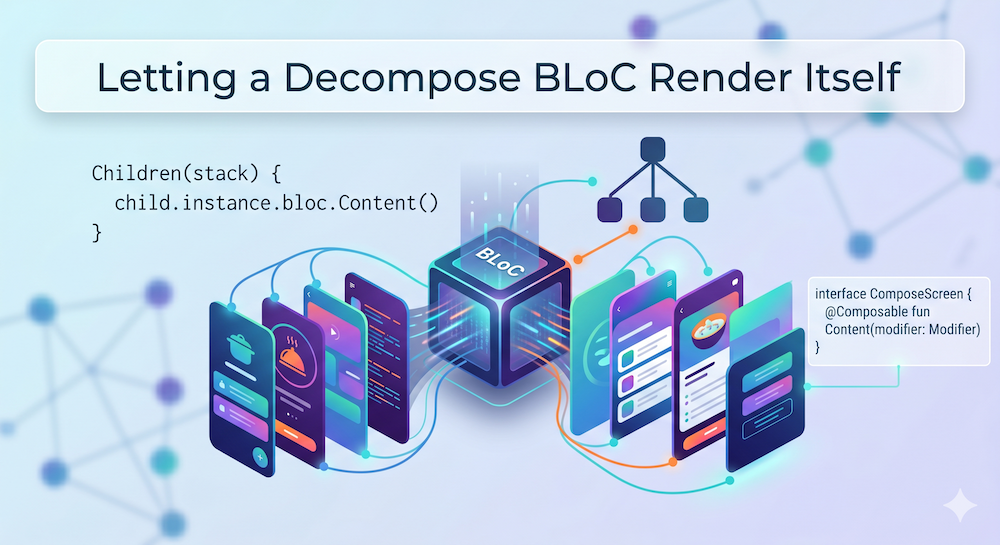
I use Decompose to manage navigation in my Kotlin Multiplatform projects. It does a great job of modeling navigation as a tree of business logic components (BLoCs) that are completely platform- and UI-agnostic. But that agnosticism comes with a small tax: something, somewhere, still has to decide which composable to draw for each BLoC. This post is about how I got rid of that boilerplate by giving each BLoC the ability to render itself since Chef Mate uses Compose Multiplatform to render its UI.
The Problem
Decompose hands you a sealed Child hierarchy and a Children/Child slot to render. The library deliberately knows nothing about your UI, so the wiring between a Child variant and its composable lives in your render site as a when block:
Children(stack = bloc.routerState) { child ->
    when (val instance = child.instance) {
        is Child.CookMode -> CookModeScreen(instance.bloc)
        is Child.Detail   -> RecipeDetailScreen(instance.bloc)
        is Child.Edit     -> EditRecipeScreen(instance.bloc)
        // ...one arm per screen
    }
}
This exists purely to map a sealed variant to its composable. Every new screen means another arm, another import, and the same shape repeated across RootScreen, RecipeRootScreen, BottomNavScreen, and friends. It's the kind of boilerplate that isn't hard, just relentless.
The Idea: an Interface for Rendering
Decompose keeps logic and UI apart on purpose, and I didn't want to throw that away. So instead of registering composables somewhere, I introduced a tiny interface in my public module that simply declares "I know how to render myself":
interface ComposeScreen {
    @Composable fun Content(modifier: Modifier)
}

@Composable fun ComposeScreen.Content() = Content(Modifier)
The key detail is where the implementation lives. The interface and its default body sit in the public API module, where the screen composable is already in scope. A BLoC's interface can supply the default rendering, while the impl module — the actual implementation detail — stays free of any Compose dependency:
interface CookModeBloc : ComposeScreen {
    // ...bloc state and intents...

    @Composable
    override fun Content(modifier: Modifier) {
        CookModeScreen(this, modifier)
    }
}
CookModeBlocImpl over in cook/impl doesn't change at all and gains no knowledge of Compose. The render site collapses to a single uniform call:
No when. No per-screen imports. The BLoC owns the question "what do I look like?", which felt like the natural place for it to live. (PR #198)
Standardizing the Pattern
The prototype worked, so the follow-up rolled it out across every navigation Child in the app — root, recipe, meal planner, settings, AI chat, browser, bottom nav — plus the two childSlot sheet wrappers.
Along the way I settled on a slightly different shape than the original BlocScreen by bloc delegation. Instead, the Child sealed class declares the BLoC as an abstract property and each variant overrides it:
sealed class Child {
abstract val bloc: ComposeScreen
data class Detail(override val bloc: RecipeDetailBloc) : Child()
data class Edit(override val bloc: EditRecipeBloc) : Child()
}
// render:
Children(stack = bloc.routerState) { child ->
    child.instance.bloc.Content()
}
Reading the BLoC explicitly at the render site (child.instance.bloc) turned out to be clearer than interface delegation — you can see exactly what's being rendered, and not every Child variant is a screen anyway. For example, a FullImage variant that just carries imageUrl, recipeId, and title is plain data, not a BLoC, so it stays out of the pattern entirely.
Takeaways
- Decompose stays untouched. This is a language-level interface, not a DI registry. The sealed
Configuration/Childtypes and the lazychildFactoryall work exactly as before. - The implementation module stays clean. Because the default
Content()lives in thepublicinterface where the screen is already in scope, theimplmodules never take on a Compose dependency. - Boilerplate moves to where it belongs. Each BLoC answers "how do I render?" once, and every navigation parent gets a uniform,
when-free render call for free.
Sometimes the cleanest way to bind a screen to its logic is to stop binding them at the call site at all — and let the component tell you.